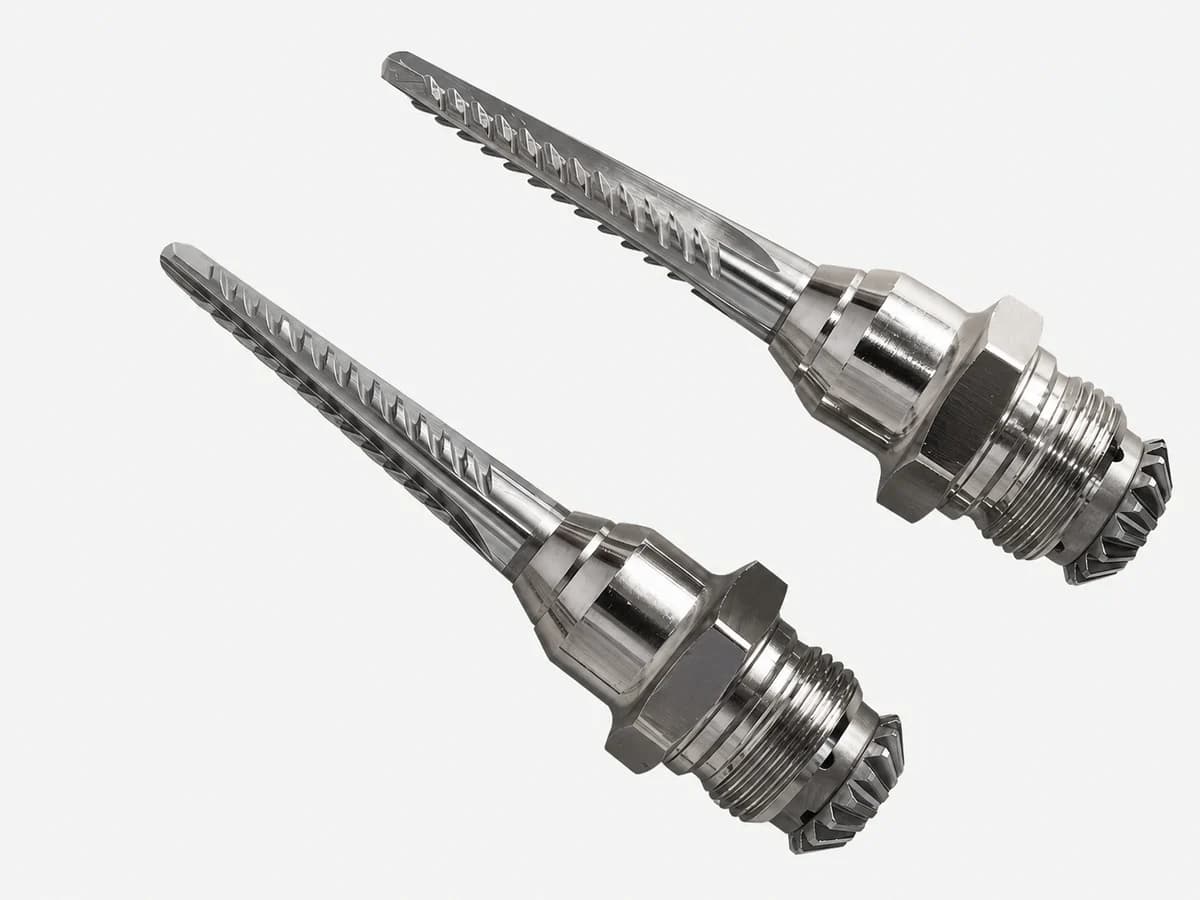
Quick checks before you begin
- Write either bare spindle or spindle assembly on the inquiry
- List every component expected in the quoted supply form
- Record the installed reference, RH/LH direction and machine context
- Keep a labeled retained sample for final comparison
Start with the supply form, not the word spindle
In parts conversations, spindle can describe the individual barbed wear component or a spindle supplied with mating components already assembled. Manufacturer parts literature lists individual spindles and spindle assemblies separately, so the quotation must do the same.
A bare spindle is the individual picking element. A spindle assembly is a preassembled service unit whose included components are controlled by its exact reference and bill of material. The word assembly alone does not prove which nut, bushings, collar, seals or other mating pieces are included.
Require the supplier to repeat the assembly reference and itemize the included components. Do not transfer a component list from another reference or machine family.
Compare the two purchasing forms
| Order field | Bare picker spindle | Spindle assembly |
|---|---|---|
| Supply boundary | Individual barbed spindle only | Spindle with the mating components defined by the quoted assembly reference |
| Do not assume | Nut, bushings, collar or related hardware are included | Every assembly reference contains the same component set |
| Typical buying purpose | Controlled rebuild or bulk wear-part replenishment | Field or shop replacement where a preassembled service unit is required |
| Minimum identity evidence | Spindle reference, hand, full photos, key sample dimensions and retained original | Assembly reference, hand, installed position, full photos and itemized supply list |
| Receiving check | Count, identity, hand separation, visible condition and approved sample comparison | Identity, hand, included components, assembly condition and approved sample comparison |
Control the assembly boundary before quotation
- Record the exact current reference and any published replacement relationship without deleting the original number.
- State RH or LH as a separate field and identify how that direction was confirmed.
- Request a labeled photo or itemized list showing what arrives as one assembly.
- Identify any parts the buyer expects to reuse; do not let the supplier infer this from price alone.
- Agree the retained sample, drawing or measurement record used for first-order approval.
- Keep bare spindles and assemblies on separate quotation lines, cartons and inventory records.
Choose by the maintenance objective
Official parts literature presents the assembly as a convenient all-in-one repair form, while an individual spindle remains a separate service part. That distinction can reduce parts handling, but it does not replace inspection of the surrounding row-unit components or the machine-specific service procedure.
For a first aftermarket order, compare the complete proposed supply form with a labeled retained original. If the maintenance team intends to replace only the spindle, confirm that every reused mating component is acceptable under the applicable service information.
| Maintenance objective | Purchasing response |
|---|---|
| Replace an identified worn spindle only | Quote the bare spindle only after the reusable component decision is controlled |
| Reduce handling during a planned service job | Quote the exact assembly and confirm its included components |
| Build distributor stock | Keep separate SKUs and bins for bare spindles, RH/LH assemblies and supporting components |
| Validate a new supplier | Approve samples against retained originals before increasing order quantity |
Prepare an inquiry that cannot be misread
- Name the requested form: bare picker spindle or complete spindle assembly.
- Provide machine, row-unit and removed-position context.
- Record the exact part or assembly reference and RH/LH direction.
- Attach complete views of the loose part and its installed context when safe to obtain.
- List the expected included components and mark any point that remains unconfirmed.
- State trial quantity, annual estimate, packaging separation and receiving-inspection evidence.
Cotton harvester guidance emphasizes correct spindle hand, nut thread and drum position. Installation and reuse decisions belong to the current operator or service information and a qualified technician.
Technical basis for this article
The article paraphrases and organizes the sources below. It does not copy a service manual, and it does not replace the current documentation for the exact machine.
- John Deere Parts Catalog: Cotton Parts and AttachmentsJohn Deere | technical guideOpen source
- AKK18840 Pro-XL Spindle AssemblyJohn Deere Parts | technical guideOpen source
- Preseason Procedures for Spindle-Type Cotton HarvestersCotton Incorporated | technical guideOpen source
- Cotton picker parts inquiry data standardYUCHENG HARVEST | internal standardOpen workflow
Questions buyers and technicians ask
Is a spindle assembly the same as a spindle nut assembly?
Do not assume so. Product naming and included components are reference-specific. Ask for the exact reference, an itemized component list and a photo of the complete quoted supply form.
Can one product photo confirm whether I need a bare spindle or an assembly?
A photo can show the general supply form, but it cannot reliably confirm reference, RH/LH direction, thread, included components or machine fitment.
Which option costs less?
A bare spindle has fewer supplied components, but the repair decision should consider reusable-part condition, labor, downtime and receiving risk. Request separate controlled quotations rather than comparing unit price alone.
Can a bare spindle be installed in any existing spindle nut?
No universal compatibility should be assumed. The spindle must match the required hand, thread, geometry and machine context, and reused components must pass the applicable service decision.